
In an effort to end the trance of suffering by Johnny Morrow
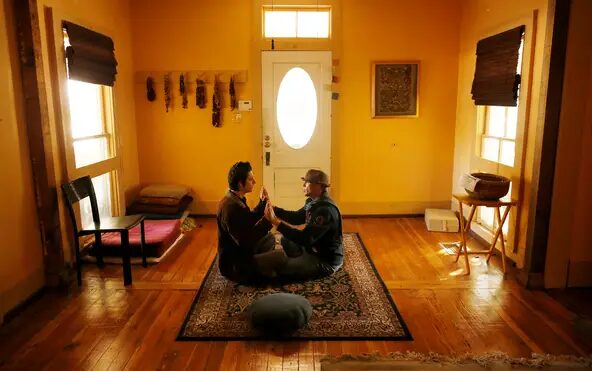
At the Gainesville Zen Center
An Essay on Human Psychology and Transcendence
From this essay : (In my own case the transition from a mostly unconscious pattern of behavior to a more conscious and fully alert practice came with the support and guidance of a teacher who herself had practiced for years and for me was also brought about by suffering and self-hatred.)
Questions:
1. Do you find the purpose of psychotherapy, therapy, or psychology to be the investigation and understanding of our own identities and minds to manage symptoms, cope with life, etc. ?
2. Are you open to the possibility of a new type of psychology, transpersonal psychology, or parapsychology which aims at the transcendence of the personal self into a universal self?
Though it is helpful to know where we are mentally and physically the knowledge of our unique mind itself can act as a hindrance to undoing habitual emotional and social patterns which keep us imprisoned in a web of suffering.
The idea of fixing oneself can itself create obstacles
Whereas the transcendence of a 'self' is not impossible and that subtle difference is the difference between psychology and parapsychology.
Ken Wilber uses the term Transpersonal Psychology
In Buddhist Traditions Yeshe Tsogyal asks Padmasambhava -- can I take disturbing emotions as the path to enlightenment?
His response is that depending on our own level of understanding about the nature of our minds disturbance can be either a teaching or further destruction. What distinguishes someones capacity to take disturbance as a path or hindrance is exactly this identification with a personal self without the additional support or understanding of transcendence.
Carl Jung's approach called 'shadow work' borders this and certain existing practices today , more or less analytical, have resemblance and make attempts at declaring transcendence of a personal self to be much more important than changing or analyzing this personal self.
Shadow work aims one to the subconscious mind - to try and investigate and include that which may be hidden from the usual personal self identity and include it so that through wholeness transcendence becomes more likely.
But these unique systems have their own limitations and are not the same; despite sharing an important interest in a universal self which has shed the more fragmentary, limited self commonly at center stage in majority psychology.
Gurdjieff said , around the time that Freud's ideas were becoming more popular and accepted
"What you call the subconscious mind, I am calling the true self!"
In parapsychology the emphasis may not simply be on getting to know what obscuration is present, but rather the very core nature of the mind and practices to cut through obscurations over and over again to arrive at the pure uncorrupted awareness.
Recognizing this unchanging awareness itself , again and again, helps to purify the existing observations and disturbances. What psychology attempts to do is arrive to this through analysis , which is helpful for a time, but has a tendency to be rooted in western belief and culture as opposed to the possibility of a universal self - transcendent of a limitation and belief rooted in awareness and direct understanding of the source of thought.
In psychology this is often termed ego. The other possibility is that this central thought "I" is what we do not fully yet understand so all energy and attention must be put there without adding new ideas to it.
In vedanta , this is known as the practice of Self - Inquiry. Where ones attention is singularly fixed on the experience of "I" and where all thought and phenomena can be directly investigated to be arising from this central thought "I".
Rupert Spira says:
"Turn your attention to the source of all thought and you will find yourself to be everywhere" as a form of self-inquiry.
Eventually with the right attention and investigation into this personal self "I" , it simply collapses and dissolves. The realization that there is not separation between self and world, truth and love, no sense of lack or need - occurs.
In Zen this is referred to as Satori, but Satori is not the end all. A glimpse or experience begins the initial interest in the mind at this sense of infinite peace and happiness.
So from there parapsychology , and self-inquiry require a devotion to practicing this until the "I" thought or personal self is completely resolved to the universal self.
Ramana Maharshi himself stated that this can be practiced in the midst of daily life , work, etc without interrupting it.
This may be another distinction between psychology and transcendent psychology which is that if traditionally psychology is an occasional or supplementary practice, this approach emphasizes an understanding of the practice and a willingness to practice in the midst of wherever or whatever you currently are.
For some this arises as a thirst to know or to practice, in others it may arise with support or encouragement from a guide or teacher, and for even others it may happen due to suffering which demands some attention.
In my own case the transition from a mostly unconscious pattern of behavior to a more conscious and fully alert practice came with the support and guidance of a teacher who herself had practiced for years and for me was also brought about by suffering and self-hatred. This encouraged a deep need to not just live with the ideas of who I thought I was but to look to transcend those ideas completely despite a strong fear that kept them in place and deep impressions from years of trancelike struggles.
This forms the basis of transitioning and transforming negative emotions and suffering into happiness and the possibility of taking everything , even disturbance, as a teaching.